
Right now, somewhere in Riyadh, Jeddah, or Dammam, someone is typing a phrase into Google close to “best place to buy…” or “how do I fix…”. The question that matters is simple: does your website show up for that search, or does your competitor’s?
That is exactly what SEO in Saudi Arabia comes down to. It is not a technical trick or a magic button that suddenly boosts your rankings — it is a set of ongoing changes and practices that help Google understand your site better, trust it more, and show it to the people already searching for what you offer.
What Is SEO, Really?
SEO is the process that gets your website to appear in organic — meaning unpaid — search results when someone searches for terms related to your product or service. The word “organic” matters here: you are not paying Google for every impression. You earn your place through the quality, content, and structure of your site.
The difference between a store that ranks on page one and one that disappears on page five is not luck. It is the cumulative result of dozens of small decisions: page load speed, content clarity, how titles are written, the number of trustworthy sites linking back to yours, and even the mobile experience.
A point many business owners miss: SEO is not a project you execute once and finish. It is an ongoing process that needs monitoring and adjustment, because Google itself constantly changes its ranking criteria, and your competitors never stop optimizing either.
The Four Core Types of SEO
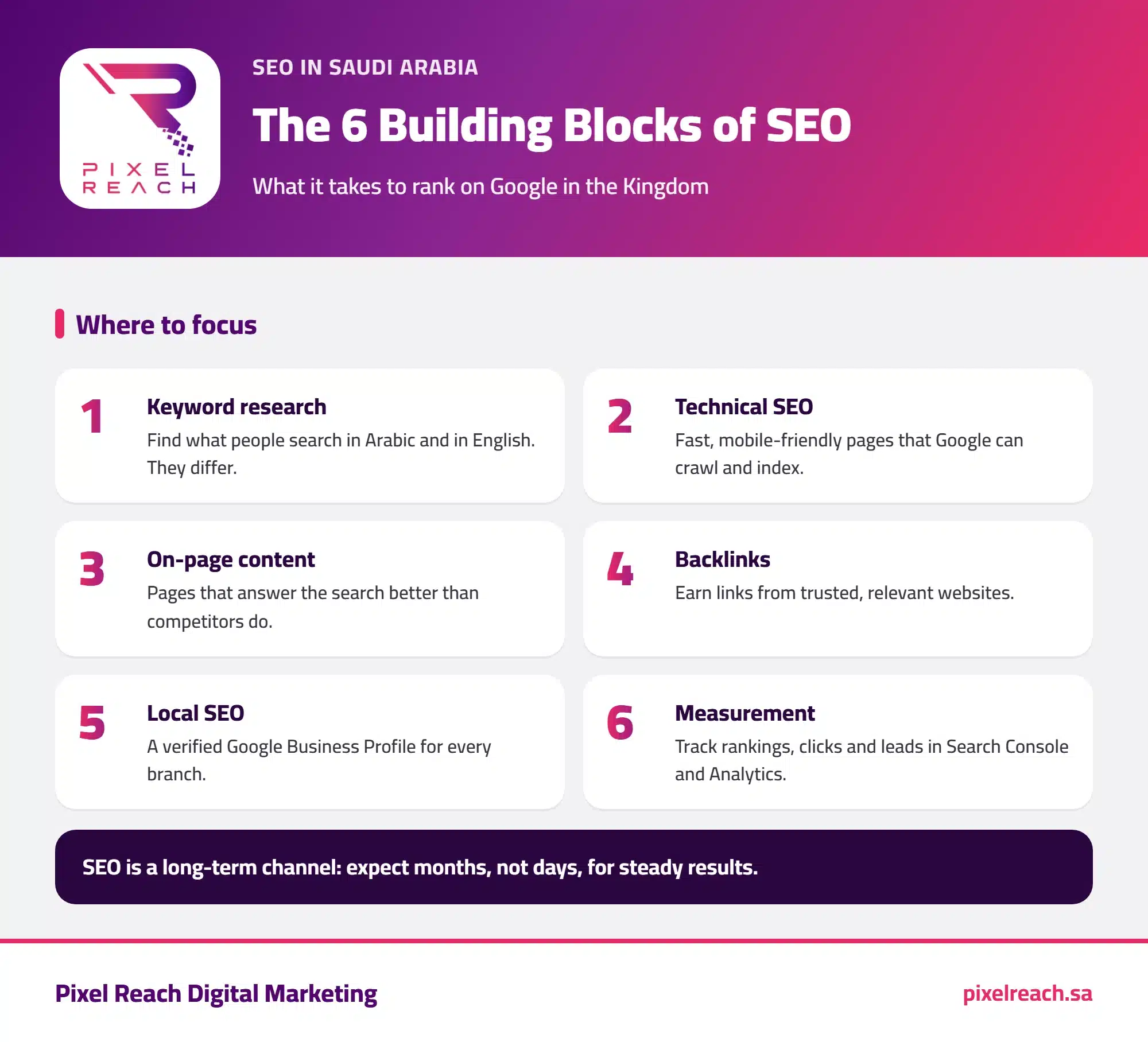
Many business owners assume SEO simply means “stuffing keywords into articles.” That is a small fraction of the picture. In practice, SEO splits into four pillars that work together:
Technical SEO
This covers your site’s back-end foundation: load speed, mobile compatibility, URL structure, the presence of an XML sitemap, and code free of errors that block Google from indexing pages correctly. A slow or technically broken site won’t be saved by even the best content in the world.
On-Page SEO (Content SEO)
This covers everything inside the page itself: writing quality, clear headings, natural keyword usage, well-described images, and internal links connecting your site’s pages to each other. For a step-by-step checklist, see our on-page SEO guide.
Off-Page SEO
This is about the trust your site builds from external sources — most notably backlinks from other reputable sites pointing to yours. Every link from a respected site acts like a vote of confidence in front of Google.
Local SEO
Critical if your business serves a specific geographic area — a clinic, a restaurant, a store with a physical branch. It covers your Google Business Profile, customer reviews, and consistent business information (name, address, phone number) across every platform you appear on.
SEO vs. Paid Ads: Which Should You Start With?
This question comes up constantly, and the honest answer is that it is not “either/or” — it is “when to use each one.”
Paid ads (like Google Ads) give you instant visibility, but that visibility stops the moment your budget does. SEO is slower at the start — it can take weeks to months before it produces measurable results — but the results stay and compound even when you are not actively spending in that moment.
In practice, serious long-term businesses invest in both: ads to cover the time gap and bring in fast sales, and SEO as the foundation that builds lasting value for the site.
SEO Steps: Where to Start
If you wanted to start today, here is the logical sequence specialists follow:
- Initial technical audit — confirm the site is free of major issues (broken pages, slow load times, indexing problems).
- Keyword research — understand what your audience is actually searching for, not what you assume they search for.
- Optimize existing pages — review current titles, descriptions, and content before thinking about adding new pages.
- Build new content that fills the gaps — articles and pages that answer your audience’s real questions.
- Build links and authority — through presence on credible sources relevant to your field.
- Measure and adjust continuously — using tools like Google Search Console to see what’s working and what isn’t.
The important point here: many sites jump straight to step four (writing content) and skip the technical foundation, only to discover later that their effort was wasted because Google couldn’t index the pages correctly in the first place.
SEO for Salla and Zid Online Stores
Anyone running a store on Salla or Zid faces a different challenge than a typical corporate website. Stores usually have hundreds or thousands of product pages, which creates opportunities and problems at the same time.
The opportunity: every product is a page that can rank independently in Google, meaning far greater visibility potential than a traditional corporate site.
The common problem: duplicate product descriptions copied from suppliers, unoptimized product titles, and empty or thin category pages. Both platforms let you edit core SEO elements (titles, descriptions, URLs), but many store owners never actually use these settings.
Tools to Monitor Your Site’s Performance
You don’t need a huge budget to get started. A few free tools are enough for the beginning:
- Google Search Console: shows how Google actually sees your site, and which keywords it currently ranks for.
- Google Analytics: shows where your visitors come from and what they do on the site.
- Google PageSpeed Insights: measures site speed and flags technical weak points.
Later, as your site grows, paid tools (like Ahrefs or SEMrush) become useful for deeper competitor analysis, but they are not necessary at the first stage.
Common Mistakes That Slow Down SEO Results
- Expecting instant results: SEO is a cumulative investment — seeing clear results usually takes months, especially for a new site that hasn’t yet built enough trust with Google.
- Copying content from other sites: this hurts your ranking rather than helping it.
- Neglecting the mobile experience: most searches today happen on mobile, and a site that doesn’t run smoothly on it loses a large share of its opportunities.
- Targeting one overly broad keyword: instead of chasing a highly competitive generic term, it’s better to start with more specific keywords that are easier to rank for first.
How Much Does SEO Cost in Saudi Arabia?
Cost varies significantly based on site size, competition level in your field, and the scope of service (a one-time audit versus ongoing monthly management). Broadly, the Saudi market shows a wide range of packages, from limited-scope services for small sites to full management contracts for large, highly competitive stores.
When comparing offers, don’t look at price alone — ask exactly what’s included: does it cover a technical audit? Content writing? Link building? Regular performance reports? A cheap offer with no clear scope of work usually means limited results.
How to Choose a Trustworthy SEO Agency in Saudi Arabia
Before signing with any agency, ask yourself these questions:
- Do they explain their plan clearly, or do they give you vague promises of a “guaranteed first page”? (No one can guarantee a specific ranking on Google, and any agency claiming otherwise deserves skepticism.)
- Do they provide clear, regular reports showing actual progress?
- Do they have prior experience in your specific field or market?
- Do they use methods compliant with Google’s guidelines (White Hat SEO), or do they rely on shortcuts that could hurt your site later?
A good agency tells you honestly that results take time, and focuses on building a solid foundation instead of quick promises that fade after a few months. For the full checklist, including ten red flags and the questions to ask before signing, read how to choose an SEO company in Saudi Arabia.
The Numbers Speak: Why SEO Is a Smart Investment in Saudi Arabia Right Now
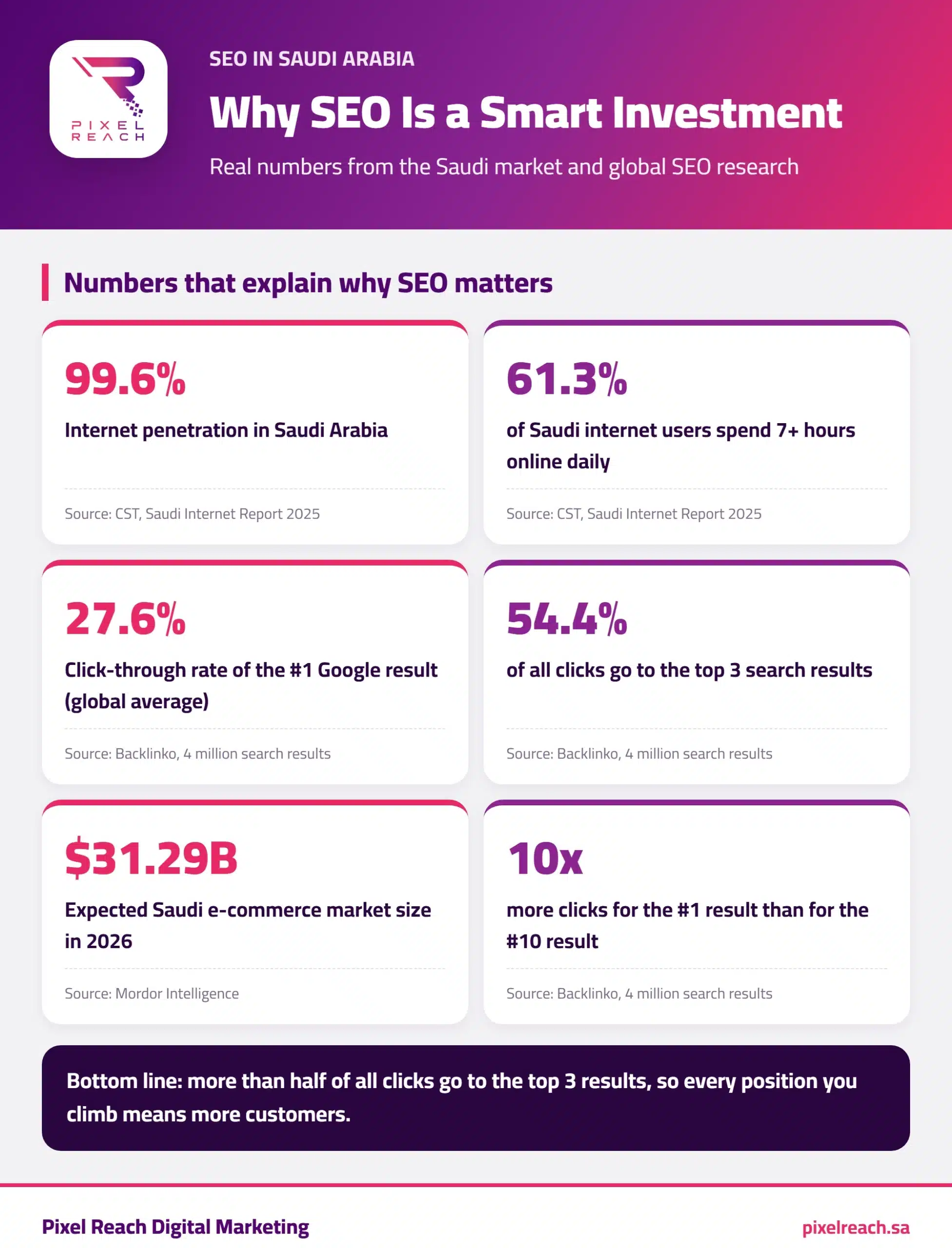
Talk about SEO often stays theoretical, but the actual numbers show why it’s a serious investment rather than a luxury:
- Internet penetration in Saudi Arabia reached 99.6% of the population, according to the “Saudi Internet 2025” report from the Communications, Space and Technology Commission (CST) — a figure that places the Kingdom among the most connected countries globally.
- 61.3% of Saudi internet users spend more than 7 hours online daily, per the same report — meaning your audience is nearly always connected, and the question is whether they find you when they search.
- Globally, a Backlinko analysis of more than 4 million search results found that the #1 Google result captures an average of roughly 27.6% of all clicks, while the top 3 results together capture 54.4% of all clicks, according to Backlinko’s analysis of about 4 million search results. In other words, ranking on page two effectively means you don’t exist for most searchers.
- Saudi Arabia’s e-commerce market is estimated at roughly $31.29 billion for 2026, with projected annual growth exceeding 11% through 2031, according to Mordor Intelligence — a market growing at this pace means escalating competition for visibility, and whoever builds their SEO presence early holds a cumulative advantage that’s hard for new entrants to catch up to later.
- The gap between the top and the bottom of the page is large: the #1 Google result gets about 10 times more clicks than the #10 result, according to the same Backlinko analysis.
These numbers don’t mean SEO will give you instant results, but they do show the real size of the opportunity in the Saudi market, and why delaying the start costs more than the start itself.
Frequently Asked Questions (FAQ)
How long does it take to see SEO results?
First signs of improvement usually begin within 2-4 months, while clear, stable results may take 6 months or more, depending on competition in your field and your site’s starting condition.
Is SEO suitable for small and new businesses?
Yes — it’s often more worthwhile for small businesses in the long run, because it doesn’t require a continuous ad budget, and it builds value that persists even when direct investment temporarily pauses.
Can I do SEO myself without a specialized agency?
The basics, yes — they can be learned and applied, especially on ready-made platforms like Salla or Zid that offer direct SEO settings. But as your site grows and competition increases, having a specialist or dedicated team becomes a real difference in speed and precision.
Is SEO better than Google Ads?
There’s no absolute “better” — the two serve different goals. Ads suit instant results, and SEO builds a long-term digital asset. Combining both usually delivers the best return.
Sources
- Communications, Space & Technology Commission (CST) — “Saudi Internet 2025” report: internet penetration and daily usage rates. cst.gov.sa
- Backlinko — organic click-through rate (CTR) analysis based on more than 4 million Google search results. backlinko.com
- Mordor Intelligence — Saudi Arabia e-commerce market size report and growth projections through 2031. mordorintelligence.com
Ready to turn this into results for your business? Explore Pixel Reach’s SEO services in Saudi Arabia and get a free consultation tailored to your market and goals.
Want your website on the first page of Google?
Send us your website link, and we will review it and suggest a clear SEO plan that fits your business and budget.
Chat on WhatsAppRequest a Quote