
Two coffee shops open on the same street in Riyadh. Same beans, similar prices, similar interiors. A year later, one has a queue every evening and customers posting its cups on Instagram. The other is running discounts to fill tables. The difference is rarely the coffee. One of them knows exactly who it is and says so in every detail. The other is simply a place that sells coffee.
That difference is brand identity. In this guide we explain what brand identity really means, how it differs from branding and from a logo, the seven building blocks behind every strong brand, a practical way to build yours, and what changes when your customers are in Saudi Arabia.
What Is Brand Identity?
Brand identity is the full picture you want people to hold of your business: who you are, who you serve, what you promise, how you sound, how you look, and how customers feel after dealing with you. It is your answer to a simple question every customer asks silently: why you, and not the shop next door?
Your logo and colors are how that answer is seen. They are not the answer itself.
Brand Identity vs. Branding vs. Brand Image
These terms get used interchangeably, which is why so many projects start in the wrong place. Here is the short version:
| Term | What it means | Who controls it |
|---|---|---|
| Brand identity | Who you intend to be: values, positioning, promise, voice, visuals | You |
| Branding | The ongoing work of building and expressing that identity | You and your team or agency |
| Brand image | What customers actually think of you | Your customers |
| Visual identity | The visible layer: logo, colors, type, imagery | You |
The goal of branding is to close the gap between your brand identity and your brand image, so that what people think of you matches what you set out to be.
The 7 Building Blocks of a Brand Identity
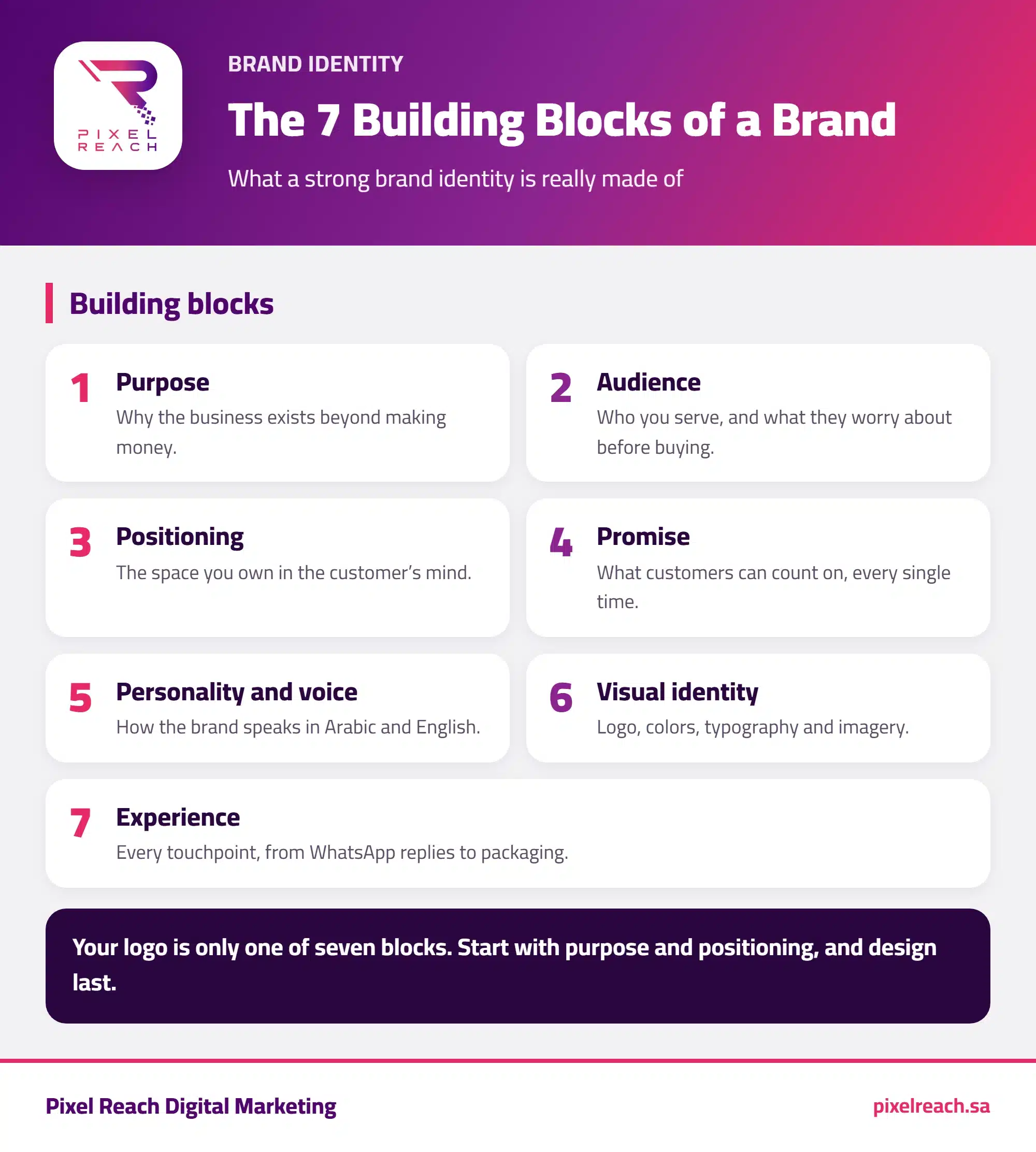
- Purpose: why the business exists beyond making money. Two honest sentences beat a paragraph of corporate language.
- Audience: who you serve, and what worries them before they buy. “Everyone” is not an audience.
- Positioning: the space you want to own in the customer’s mind compared with competitors: the fastest, the most premium, the most specialised, the easiest to deal with.
- Promise: what customers can count on every time. Specific promises (“we reply within an hour”) beat vague ones (“quality service”).
- Personality and voice: if your brand were a person, how would it talk? Formal or friendly, serious or light?
- Visual identity: the logo, colors, typography and imagery that make everything above visible. Our visual identity guide covers this layer in detail.
- Experience: every touchpoint, from the first WhatsApp reply to delivery and after-sales service.
How to Build a Brand Identity in 6 Steps
- Talk to real customers. Ask why they chose you, what nearly stopped them, and how they describe you to friends. Their words are often better than anything you would write.
- Map your competitors. Note what each one promises and how it sounds. Look for the gap nobody is filling.
- Write your positioning statement. A simple template: “For [audience] who [need], we are the [category] that [key difference], because [proof].”
- Choose a few values that change decisions. Test each one: did it change a decision we made this month? If not, it is decoration.
- Define your personality and voice. Write words you use and words you never use, in both Arabic and English.
- Design, apply and measure. Only now design the visual identity. Then apply it everywhere, and listen to how customers describe you. That is your brand image talking back.
Brand Strategy in Saudi Arabia: What Changes
Most branding advice is written for Western markets. A few things matter much more here:
- Two languages, one personality. Your brand must sound like the same person in Arabic and English. Many brands are warm in Arabic and stiff in English, or the reverse.
- Names that work both ways. Check how your name reads, sounds and is spelled in both scripts, and whether customers will search for it in Arabic, English, or both.
- WhatsApp is a brand channel. For many Saudi customers, your WhatsApp replies are the brand experience. Tone, speed and consistency there matter as much as your logo.
- Cultural moments. Ramadan, Eid, Saudi National Day and Founding Day are part of the brand calendar. A strong identity flexes for them without losing itself.
- Protect it early. Register your name and logo as a trademark with the Saudi Authority for Intellectual Property (SAIP) before you invest heavily in them.
One Message, Three Brand Voices
Voice is part of brand identity, not an afterthought. Here is the same delivery-delay message written for three different brand personalities:
| Brand personality | Message |
|---|---|
| Formal and trusted | We apologise for the delay to your order due to high shipping demand. It will arrive within 24 hours. Thank you for your patience. |
| Warm and friendly | Your order is running a little late because of shipping traffic, sorry about that! It will be with you tomorrow, and we will message you the moment it leaves. |
| Playful and young | Your order got stuck in traffic, just like the rest of us. It arrives tomorrow, and the next one comes with a discount on us. |
None of these is wrong. What matters is choosing one that fits your customers and using it everywhere.
When Is It Time for Rebranding?
Rebranding is expensive and risky, so do it for the right reasons:
- Your audience or services have changed significantly.
- Your current brand no longer reflects the level your business has reached.
- You are merging with another company or expanding into new markets.
- Customers regularly confuse you with a competitor.
“We are bored of the logo” is not on the list. Customers are usually not bored of it at all. Often a refresh, keeping what people already recognise, is smarter than a full rebrand.
Common Brand Identity Mistakes
- Starting with the logo before deciding who you are and who you serve.
- Generic values such as “quality and professionalism” that every competitor also claims.
- Trying to appeal to everyone, which produces a brand nobody remembers.
- A beautiful brand book that the team has never read.
- Copying a successful competitor instead of building your own personality.
Frequently Asked Questions
Is brand identity the same as a logo?
No. The logo is one part of the visual identity, and the visual identity is one part of the brand identity. A business can have a great logo and a weak brand.
Does a small business need a brand identity?
Yes, arguably more than a large one. A small business cannot outspend competitors, so it needs to be clearer than them. A one-page brand identity is enough to start: who we are, who we serve, what we promise, and how we speak.
How long does it take to build a brand identity?
The strategy work usually takes a few weeks, and a full identity including visual design typically takes four to eight weeks, depending on how quickly decisions are made.
What is the difference between brand strategy and brand identity?
Brand strategy is the plan: who you target, how you position yourself, and how you will win. Brand identity is how that strategy is expressed: your promise, voice and visuals.
Next Step
Strong brands start with questions and end with design, not the other way around. If you want your brand built in that order, from understanding your customers and positioning to a complete visual identity, explore our brand identity design services in Saudi Arabia.
Need a visual identity that sets your brand apart?
Tell us about your business and audience, and we will suggest the right direction for your identity and logo.
Chat on WhatsAppRequest a Quote